If promising farm technologies can succeed in pilots, how do we ensure they make it onto working farms after testing?
That question was at the centre of the discussion at the 9th Smart Carbon Farming (SCF) Partner Meeting. Hosted by 3N Kompetenzzentrum and TGO AG with support from Bax Innovation, more than 20 representatives from research institutes, AgTech developers, farming organisations and regional authorities met in Lower Saxony, Germany, on 14–15 October 2026. Over two days, we reviewed progress across the project, brainstormed ideas with local stakeholders, and visited sites where carbon farming is already being used.
The reality of carbon markets
Bernhard Aumann of TGO AG kicked off the sessions with an honest look at the voluntary carbon market. Certificates currently trade at around €5 per tonne of CO2, while the estimated environmental damage of that tonne is more than €350. Soil measurement can also take 20–40% of a farmer’s returns. At these prices, carbon credits alone are not a viable business for farmers.
As an alternative, Bernhard explored insetting. The usual approach is offsetting, where a farmer stores carbon in their soil and sells it as a credit, but at current prices that isn’t worthwhile for farmers. With insetting, a company instead pays for carbon-friendly farming within its own supply chain. A bakery, for example, would pay the farmers who grow its wheat to farm in a low-carbon way, and fold that cost into the price of its bread. By TGO’s estimate, this would only add about 2 cents to the price of a bread roll.
Guest speaker Jörg Högemann (Treuhand WSM) reached a similar conclusion from a regulatory angle. New EU rules make it very hard for companies to buy offset credits and then call their products “carbon neutral.” That removes much of the reason to buy offsets. So companies that want to cut their footprint are more likely to invest directly in their own suppliers, and food processors are well placed to do that.
What farmers need
Encouraging farmers to change their practices is not convincing when the risk of hurting their yield or income is perceived as unmanageable. Biogas took off in the region because farmers could rely on stable, long-term policy, and carbon farming needs the same. Arable farmer Roland Niebel noted that advisors often steer farmers away from complex options like agroforestry. However, models that remove that risk are already working. In one sugar beet scheme, the processor covers the extra cost of low-carbon fertiliser, so farmers earn a premium without risking their yields.
People find it easier to back benefits they can see in their own area, such as cleaner drinking water and flood protection, than an abstract carbon credit. Water utilities already pay to treat polluted water, much of it caused by farm runoff. If farming practices that store carbon also reduce that pollution, water companies have a reason to help pay for them.
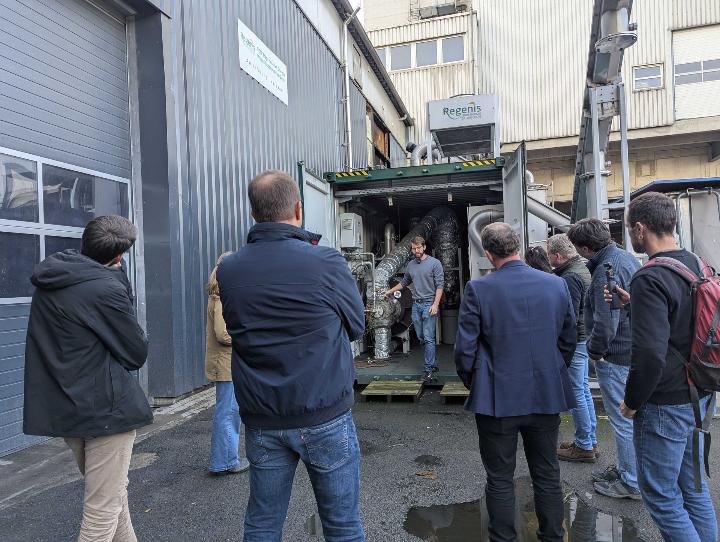
At Regenis Bioenergie, where farm biomass is turned into biochar. Photo: Caitlin Ball, Bax Innovation
Technology heading into the field
SCF’s monitoring tools are moving from the lab to the farm. Constellr’s satellites can now track peatland drying daily, ILVO’s soil-sampling robot heads to Belgian farms this autumn, and Multitel’s new soil sensor is set to join the robot in early 2027. Alongside the technology, Teagasc is leading work to test whether these tools are affordable and trusted by farmers, so they stay in use after the pilot ends.
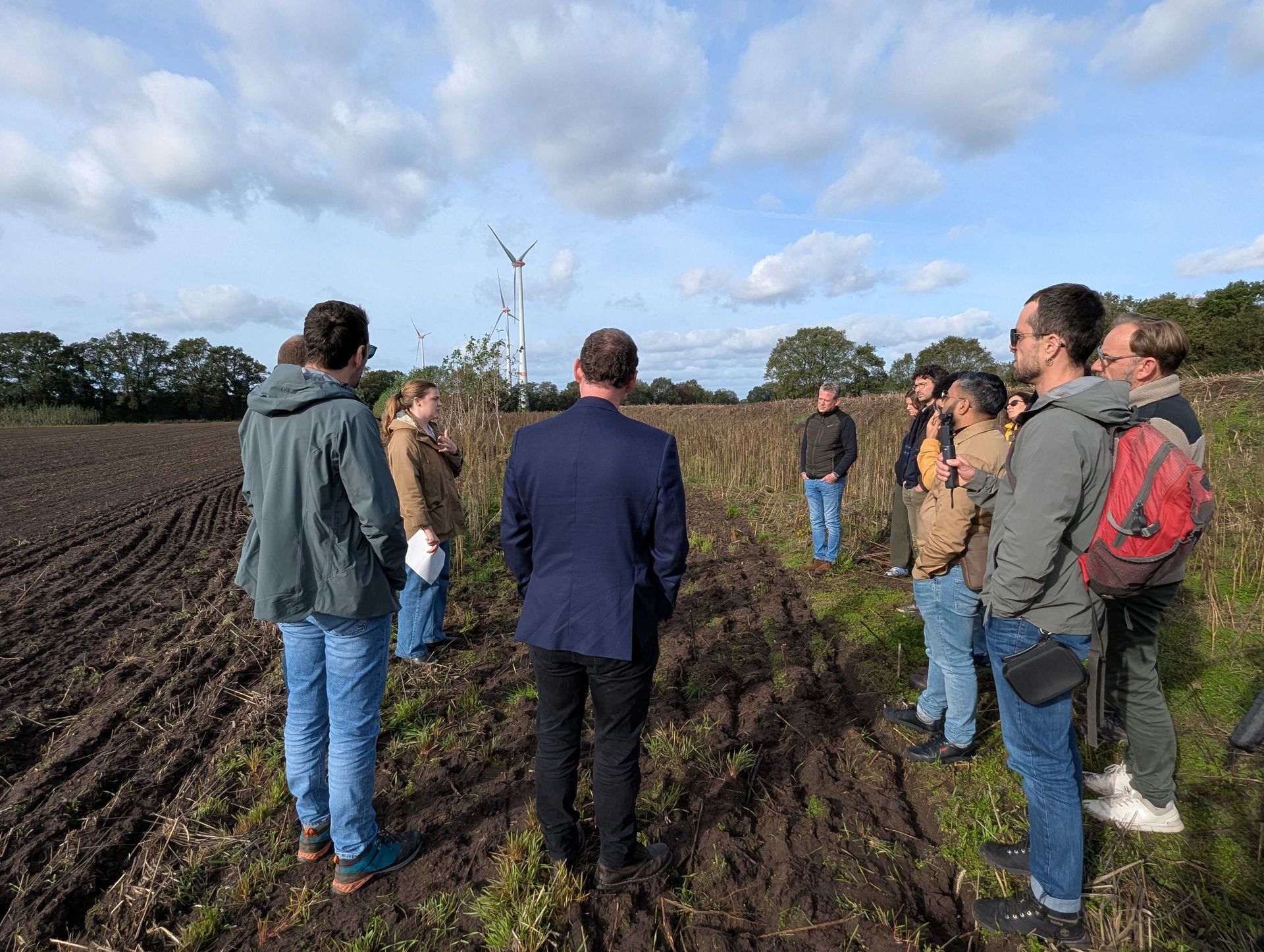
Partners visit an agroforestry trial in Lower Saxony. Photo: Caitlin Ball, Bax Innovation
A walk through the field
The conversations also made it outside the meeting room. Partners visited an agroforestry trial, a regional pyrolysis centre where farm biomass is turned into biochar, and the German Institute of Food Technologies (DIL). The visits made it possible to follow carbon from the soil all the way to the processing line.
Back at the table, the policy roundtable reminded participants of the region’s challenges. Niels Gepp of Landkreis Emsland described how fragmented land leases and land prices that have risen sixfold in a decade are holding back peatland rewetting. Sontka Jansen of Wernsing Feinkost explained how food processors are being squeezed between retailers who want both lower prices and lower emissions.
With this broader perspective, partners began planning what is next. The meeting closed with a brainstorm on carrying the project’s results further, with ideas ranging from a blueprint for local buyers’ clubs to training days built around specific crops, such as potato and sugar beet.